
My first budget was beautiful. Color coded categories, a formula that calculated my savings rate, even a little chart that turned green when I stayed under budget. I showed it to my sister like it was a newborn.
It lasted eleven days.
The problem wasn’t the spreadsheet. The problem was that I built a budget for a fictional person. Someone who never forgot a birthday, never had a tire go flat, and apparently never ate. Real me kept wrecking fictional me’s plan. And every time it happened, I felt like the failure. Not the budget.
It took three more failed budgets before I understood the difference between a budget that works on paper and one that survives a random Tuesday. Here are the signs I wish someone had pointed out earlier.
1. There’s no line for “I don’t know yet”
Every month contains expenses you cannot name in advance. A school thing. A gift. The dentist. My old budgets gave every dollar a specific job, so every surprise became an emergency.
Then I added a category called “no idea yet” and put $75 in it. That was the first month I didn’t blow the plan. Some months it goes unspent. Most months it saves the whole system.
2. Your grocery number is a wish, not a fact
I used to write $300 for groceries because that felt like what a responsible person spends. My actual receipts said $460. The budget wasn’t lying to me. I was lying to it.
Here’s the rule I follow now. The first version of any category should be last month’s real number, even if that number is embarrassing. You can shrink it later. You can’t shrink a fantasy.
3. It only balances if nothing goes wrong
If your plan needs a perfect month to work, it’s not a plan. It’s a bet. And you’re betting against a universe that invents car noises for fun.
I now assume something will cost me about $100 that I didn’t predict. When nothing does, that money rolls forward and I feel like I found it on the street.
4. You avoid looking at it after the 20th
This one is sneaky. A working budget is something you check to make decisions. A paper budget is something you avoid because it only delivers bad news.
Notice yourself skipping the app or the spreadsheet in the last week of the month? The budget already died. You just haven’t announced it yet. That avoidance feeling is what finally pushed me to a weekly 15 minute check in instead of a monthly reckoning.
5. Fun money is $0 because you’re “being serious this month”
Every time I zeroed out fun money, the same thing happened. Two weeks of discipline. Then I cracked, spent double what I would have planned, and since the budget was already broken, I kept going.
Budgets don’t fail from too much fun money. They fail from pretending you don’t need any.
6. Irregular bills keep “surprising” you
Car insurance every six months. Annual subscriptions. These are not surprises. They’re appointments. They just don’t happen monthly, so paper budgets forget them.
Setting up sinking funds for these was the biggest upgrade I ever made. Honestly, nothing in my financial life has felt as smug as paying a $340 insurance bill from a fund that already had $340 in it.
7. Only one person in the household can explain it
If your partner’s understanding of the budget is “ask before buying stuff, I think?”, the system fails the first week you’re too busy to police it. The fix isn’t a better spreadsheet. It’s a shorter one. Ours went from nineteen categories to seven before both of us could actually use it.
What actually worked for me
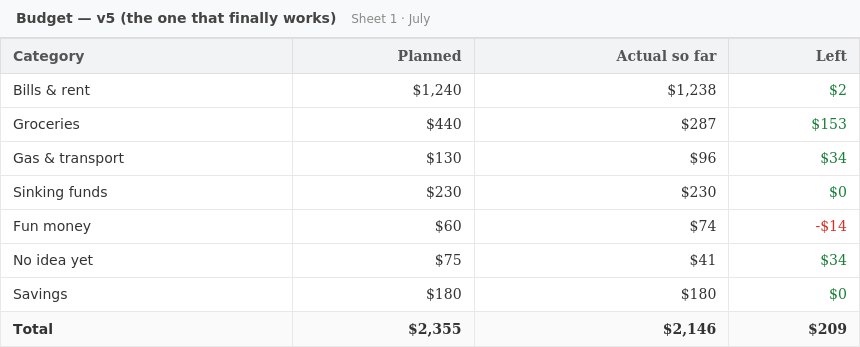
The budget I’ve kept for two years now is uglier than any of the ones that failed. Seven categories. Real numbers from real receipts. A cushion for the unknown. Fun money that exists even in tight months, because tight months are exactly when you need one small yes.
Paper budgets are designed to impress. Working budgets are designed to survive. If yours keeps dying by the middle of the month, don’t build a stricter one. Build an honest one.

Amelia writes Cents That Count from her kitchen table. She has quit four budgeting apps, run one no spend month, tracked every small purchase for 60 days, and still buys coffee. Everything here is tested on a real, ordinary budget first.
More about this blog →