
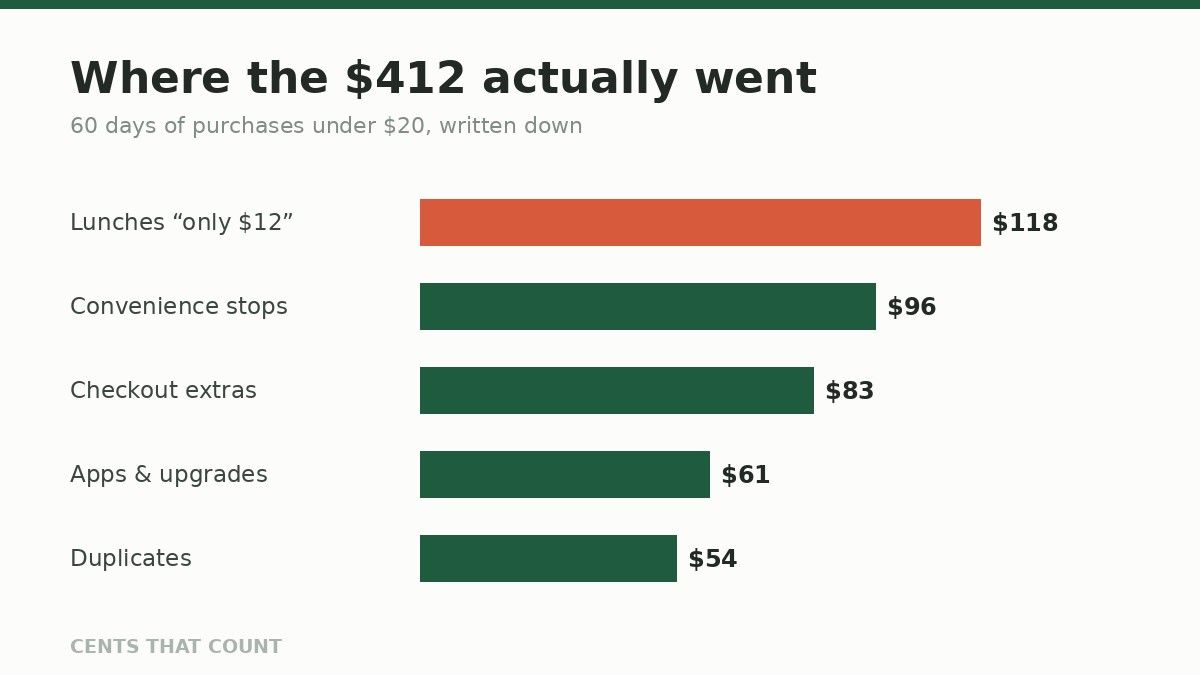
The big stuff was never my problem. Rent, insurance, the car payment. All handled, automated, boring. And yet every month ended with the same confusing gap between what I earned and what remained. I always explained that gap with a shrug and the word “stuff”.
So I decided to catch the stuff. For 60 days I wrote down every purchase under $20 the moment it happened. A note on my phone, nothing fancy. No judging and no changing my behavior, which was the hard part. Just recording.
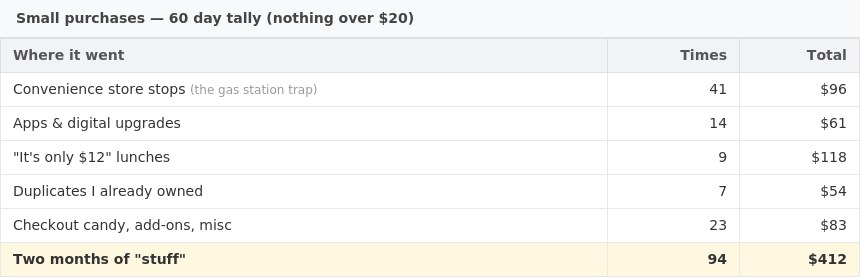
Total damage: $412 in two months of purchases I would have sworn added up to maybe a hundred bucks. Here’s the autopsy.
The convenience store tax: $96
Forty one visits. Forty one! A drink here, a snack there, a $6 stop that only existed because I was already getting gas. None of these registered as spending while they happened. That’s exactly what made them dangerous. They lived below the level where my brain bothers to notice.
Apps and little upgrades: $61
A $3.99 app. A $1.99 upgrade. $4.99 to remove ads from something. Digital purchases were the most invisible of all. No bag, no receipt, no moment where the money felt real.
Some I couldn’t even remember when I reviewed the list. I paid $4.99 for something in week two and I still could not tell you what it was.
The “it’s only $12” lunches: $118
I bring lunch most days. I believed that fact meant I don’t spend on lunch. But “most days” had quietly become three days a week, and the other two days of $12 to $15 lunches became the single biggest line in the whole experiment.
The lie wasn’t the lunches. The lie was the phrase “most days” doing unpaid PR work for my self image.
Duplicate purchases: $54
Batteries I already owned. A phone cable to replace one that was in a drawer the whole time. Two identical bottles of a spice I apparently panic buy every time a recipe mentions it. I now own four bottles of smoked paprika.
This category is pure organization failure. The money didn’t buy anything. It bought not having to go look.
Miscellaneous almosts: $83
Checkout candy. A magazine, in this decade. Donation add ons at the register. A dollar here, three dollars there. Each one too small to matter and all of them together bigger than my electric bill.
What I changed, and what I refused to change
I did not become the person who never buys a snack. Life is long. Instead, three specific changes based on what the data actually said:
- Convenience stores. I keep drinks and snacks in the car now. Visits went from 41 in two months to about 6. That one habit is worth roughly $500 a year.
- Digital stuff. Every want goes on a list first and waits for Friday. About 70 percent don’t survive until Friday. The famous 24 hour rule never worked for me, but Friday batching did.
- Lunches. I stopped saying “most days” and started counting. Twice a week is now a planned treat instead of a slow leak wearing a disguise.
The duplicates fixed themselves the day I spent one hour organizing the drawer of shame.
Should you do this?
If your months end with an unexplained gap, yes. But follow the one rule that made it work. No behavior changes while you track. The moment you start performing for the notebook, the data turns into fiction.
You need sixty days of the real you. The real me cost $412. Yours might be cheaper. I hope it involves less paprika.

Amelia writes Cents That Count from her kitchen table. She has quit four budgeting apps, run one no spend month, tracked every small purchase for 60 days, and still buys coffee. Everything here is tested on a real, ordinary budget first.
More about this blog →