
Let me save you some time. This is not a list of ways to make $5,000 a month from your couch. Those articles are written by people whose actual side hustle is writing those articles.
This is the boring version. Five things I actually do, in the real world, that add somewhere between $200 and $400 to a tight month. None of them are glamorous. All of them are real, and I’ll tell you the honest numbers including the disappointing ones.
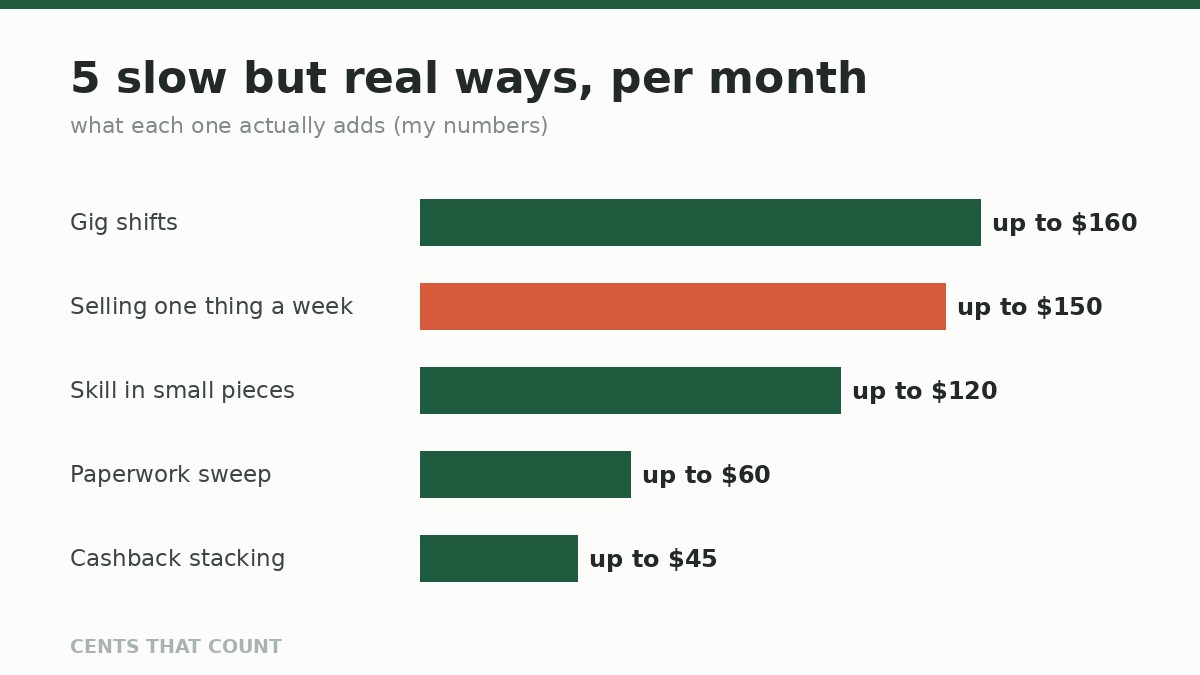
1. Selling one thing a week: $60 to $150 a month
Not a dramatic decluttering weekend. Just one item, listed properly, every week. A sustained trickle beats a garage sale blitz because the effort stays small enough to actually continue.
The trick that changed my results was photographing things next to a tape measure and writing honest descriptions. My stuff started selling in days instead of weeks. What sells and what doesn’t deserves its own story, and I wrote that one here.
2. Grocery store pickup jobs, the occasional shift: $80 to $160 a month
Delivery and shopping apps are flooded, and full timing them is rough. But two or three shifts a month, timed for the busy windows like Sunday mornings, still pays real money where I live. I treat it as a dial, not a job. Tight month coming? Turn the dial up. Normal month? Leave it off.
3. Cashback stacking on things I was already buying: $25 to $45 a month
Notice the small number. This one gets oversold everywhere, so here’s the honest version. A cashback card paid in full monthly, one supermarket app, and one browser extension. Together they return maybe $30 in an average month.
The rule that makes it real savings instead of a spending excuse is simple. Never buy anything because of the cashback. The moment a deal makes you spend, the app is earning money off you, not for you.
4. The skill I already had, sold in small pieces: $50 to $120 a month
Mine is fixing written English for small business owners. Menus, websites, email templates. Two or three little jobs a month through word of mouth and a local Facebook group.
Yours is something else. Everyone has one skill people casually ask them for help with. The move is charging a small, friendly, specific price instead of doing it free forever. My first paid job came from saying “I charge $40 for that” to someone who had asked twice for free. She said fine so fast I realized I’d been the only obstacle.
5. The annual paperwork sweep: $20 to $60 a month, averaged
Once a year I spend one painful Saturday calling providers. Internet, insurance, phone. Every year that Saturday finds money. Last year it was a loyalty discount on internet I only got by asking, a car insurance requote that came in $19 a month lower, and a phone plan I was overpaying by 40 percent because my usage had changed and my plan hadn’t.
Averaged monthly, that one Saturday pays better than any app on this list.
What I’d skip
Surveys, honestly. I tested three sites for a month and made $11 total at a rate of roughly two dollars an hour. Watching my own numbers taught me the filter I now use for everything. If it can’t reliably beat $10 an hour, my hours are worth more somewhere else, including resting.
The real math of a tight month
None of these five will change your life alone. Together, on a motivated month, they’ve covered my groceries. On a lazy month they’ve covered the electric bill. Either way, the gap between income and expenses got wider, and that gap is the entire game. Small numbers, moved repeatedly, in the right direction.
Photo by 401(K) 2013, source (CC BY-SA).

Amelia writes Cents That Count from her kitchen table. She has quit four budgeting apps, run one no spend month, tracked every small purchase for 60 days, and still buys coffee. Everything here is tested on a real, ordinary budget first.
More about this blog →