
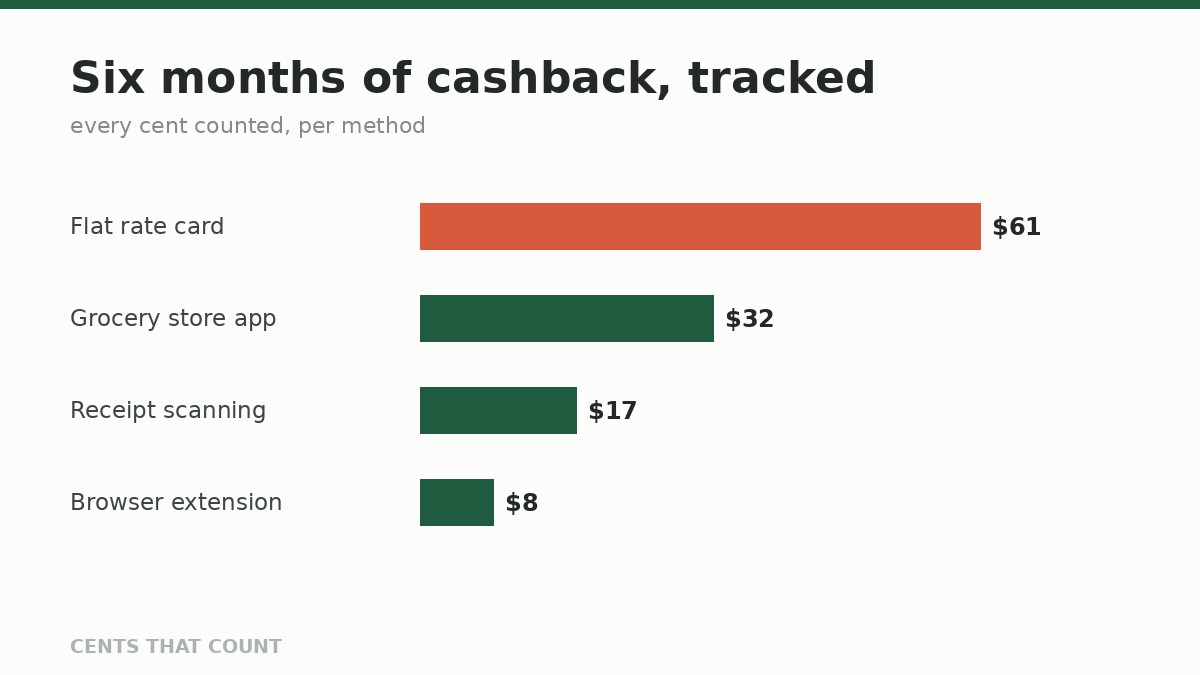
For six months I ran every popular cashback method side by side and tracked every cent in a spreadsheet, because the internet is full of claims and suspiciously light on receipts. Total earned across everything: $118.42. Not nothing, not a salary. Here’s the ranking, with real numbers and the catches nobody mentions.
First place: the flat rate cashback card, $61
Boring wins. A no-fee card returning a flat percentage on everything, paid in full every month, produced more than half the total while requiring zero thought. No categories to activate, no receipts to scan, no app to remember.
The catch, and it’s the catch that rules this whole subject: the card only earns if it never charges interest. One month of carrying a balance eats a year of rewards. The card companies aren’t confused about this math. They’re counting on it.
Second place: the grocery store’s own app, $32
The store I already shop at has digital coupons and personalized offers in its app. Clipping the relevant ones during my Sunday list writing takes four minutes and reliably knocks $6 to $9 off the weekly shop for things I was buying anyway.
The catch: the app works hard to make me buy things I wasn’t buying anyway. The offers page is a minefield of “spend $25 on snacks, get $3”. Discipline required: clip only what’s already on the list, never shop from the offers.
Third place: receipt scanning apps, $17
Scan receipts, earn points, eventually redeem gift cards. Seventeen dollars over six months of scanning nearly every receipt. Per minute of effort, this was the weakest performer that still made the podium. It survives in my routine only because scanning happens while coffee brews. If it took dedicated time, it would be gone.
The catch: the payout thresholds are designed for you to quit before reaching them. Points expire, balances sit at $4.75 forever. Getting actual money out requires the persistence of a hobbyist.
Fourth place: browser cashback extensions, $8.42
The famous ones that pop up at checkout. In six months, $8.42, and I had to fight the suspicion that activating the extension sometimes hid better coupon codes it didn’t profit from. Also, the constant “you could be earning!” notifications are engineered shopping encouragement. I uninstalled at month five and consider the $8.42 payment for the lesson.
The overall verdict
$118 for six months is about $20 a month, and 80 percent came from the two lowest effort sources. So my keep list is short: the flat rate card for everything, the grocery app clipped from the list, and receipt scanning strictly as a coffee-brewing ritual.
One rule governs all of it, the same rule from my tight month toolkit: cashback on things you were already buying is real money, and cashback that changes what you buy is a marketing cost you’re paying, not a reward you’re earning. The apps know which side of that line their profits live on. Now you do too.

Amelia writes Cents That Count from her kitchen table. She has quit four budgeting apps, run one no spend month, tracked every small purchase for 60 days, and still buys coffee. Everything here is tested on a real, ordinary budget first.
More about this blog →